Arch
An arch is a curved structure that spans an opening and supports the load above it by turning vertical forces into compression along its curve, pushing outward and downward onto its supports.
Origin From Old French arche, from Latin arcus, a bow.
Sample entry from the theme's demo content, shown to preview the layout.
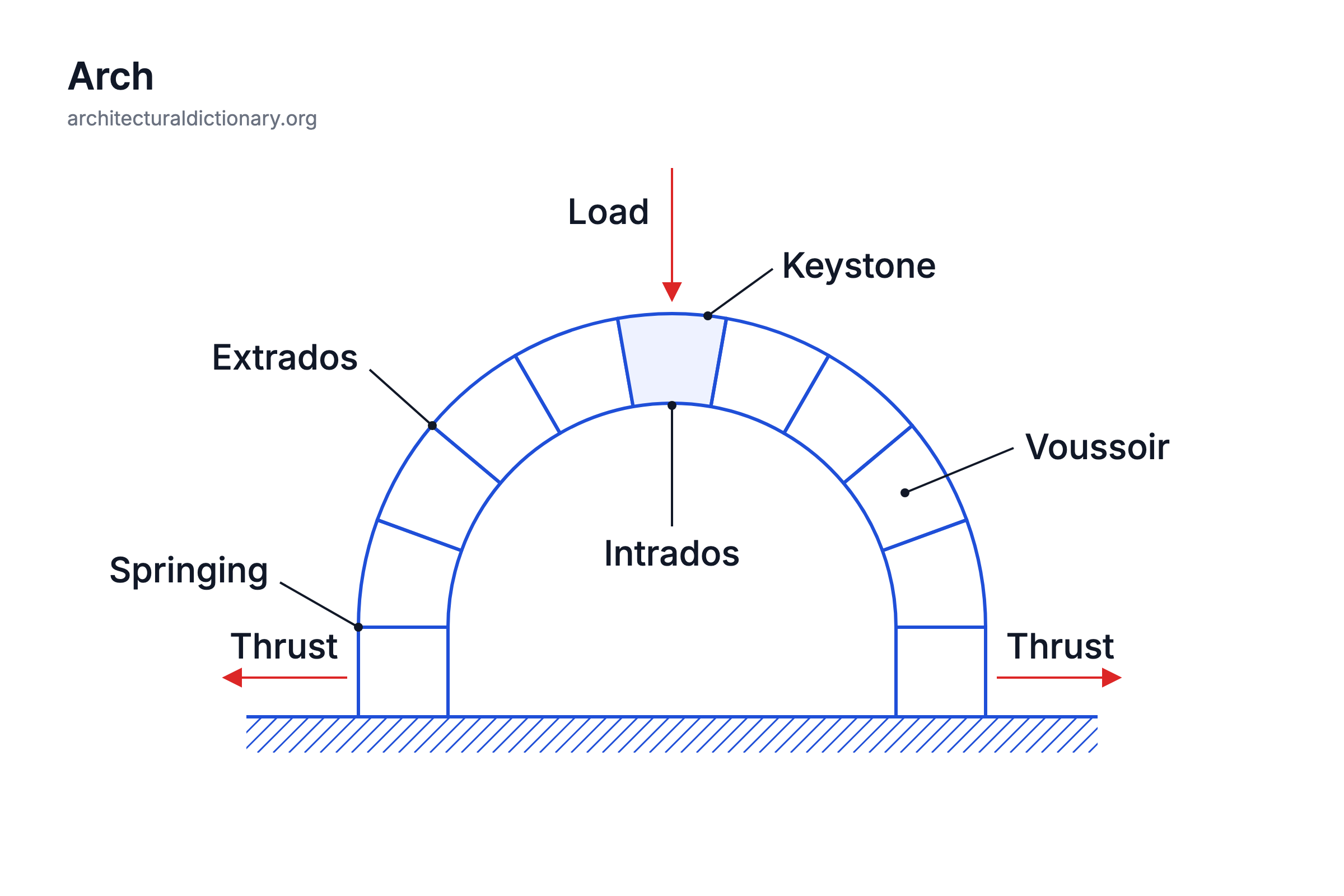 (open the full size diagram)
Save to Pinterest (opens in a new tab)
How an arch works
A masonry arch is built from wedge-shaped blocks called voussoirs, with a central keystone at the top. Each block presses against its neighbours, so loads from above are carried around the curve in compression and down to the supports. This suits stone, brick and concrete, which are strong in compression but weak in tension. An arch also pushes outward at its base, so it needs firm abutments, thick walls, buttresses or neighbouring arches to resist that horizontal thrust. During construction an arch cannot stand until the keystone is in place, so it is built over a temporary timber framework called centering.
Arches were built in ancient Mesopotamia and Egypt, but it was the Romans who used the round arch on a large scale in aqueducts, bridges, amphitheatres and triumphal arches.
The parts of an arch include the springing, where the curve begins; the intrados, or inner curve; the extrados, or outer curve; and its span and rise. Arches are named by their shape: semicircular or round arches are typical of Roman and Romanesque buildings, pointed arches of Gothic architecture, and segmental, horseshoe, ogee and parabolic arches appear in other traditions. An arch extended in depth becomes a vault, and an arch rotated about its vertical axis forms a dome. Compared with a lintel, an arch can span a much wider opening using small units of masonry.
Famous examples of Arch
-
Pont du Gard
A Roman aqueduct bridge built of three tiers of semicircular stone arches, laid without mortar.
Frequently asked questions
What is the difference between an arch and a lintel?
An arch is curved and carries its load in compression, pushing outward at its base, while a lintel is straight and carries its load by bending. Arches can span wider openings in stone or brick, but they need abutments or buttresses to resist their thrust.
What is the difference between an arch and a vault?
An arch spans an opening in a wall, while a vault is an arch extended in depth to form a ceiling or roof. A barrel vault, for example, is essentially a continuous round arch.
What is the keystone of an arch?
The keystone is the central wedge-shaped block at the top of an arch. It is placed last, and once it is in position the arch can carry its own weight and the temporary centering can be removed.
Sources
Cite this term
Architectural Dictionary. (2026, November 15). Arch. In Architectural Dictionary. https://architecturaldictionary.org/structural/arch
"Arch." Architectural Dictionary, 15 Nov. 2026, https://architecturaldictionary.org/structural/arch.
Architectural Dictionary. "Arch." Last modified November 15, 2026. https://architecturaldictionary.org/structural/arch.