Clerestory
A clerestory is the upper part of a wall containing a row of windows set above adjacent roofs, bringing daylight into the centre of a tall space such as the nave of a church.
Topic glossary
Definitions of Gothic and medieval architecture terms, including flying buttresses, ribbed vaults, tracery, clerestories and rose windows.
7 terms
Gothic architecture emerged in northern France in the twelfth century and spread across Europe over the following three centuries. Its cathedrals are famous for their height, their vast stained glass windows and their sense of lightness, achieved with heavy stone through a set of closely linked structural ideas.
The key elements work together. The pointed arch can be made taller or shorter for a given span, which made ribbed vaults over bays of different shapes possible. The ribbed vault gathers the weight and outward thrust of the ceiling into a few points, and flying buttresses carry that thrust across the aisles to massive piers outside. With the loads concentrated in this way, the walls between the piers could be opened up for glass.
Other terms describe how that opportunity was used. The clerestory is the upper zone of windows, the triforium is the arcaded band below it, and tracery is the stonework that divides windows into patterns, reaching its most dramatic form in the rose window. The evolution of tracery is so distinctive that it is often used to date buildings.
Each entry in this glossary gives a concise definition, explains how the element works, names cathedrals and churches where you can see it, and links to related terms, so you can trace how each part of a Gothic building depends on the others. Cross sections show how thrust travels from the vault to the ground.
A clerestory is the upper part of a wall containing a row of windows set above adjacent roofs, bringing daylight into the centre of a tall space such as the nave of a church.
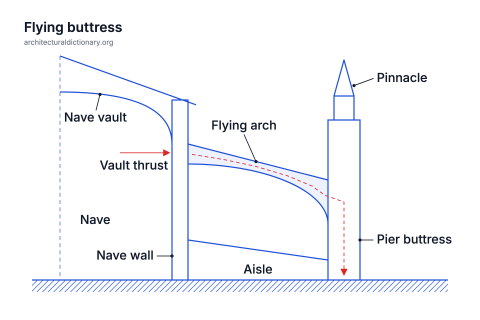
A flying buttress is an arch or half arch that springs from the upper wall of a building across an open space to a separate pier, carrying the outward thrust of a vault or roof down to the ground.
A pointed arch is an arch formed by two curved sides that meet at a sharp point at the top, directing more of its load downward than a round arch and characteristic of Gothic architecture.
A ribbed vault is a masonry vault in which a framework of diagonal and transverse arched ribs is built first and the thinner panels, called webs, are then filled in between the ribs.
A rose window is a large circular window, typical of Gothic churches, divided by stone tracery radiating from the centre into petal-like sections filled with stained glass.
Tracery is the decorative stonework of ribs and bars that divides the upper part of a Gothic window into ornamental patterns and holds the panels of glass in place.
A triforium is a shallow arcaded gallery in the interior wall of a church, set above the main arcade and below the clerestory windows, usually opening onto the space beneath the aisle roof.