Flying buttress
A flying buttress is an arch or half arch that springs from the upper wall of a building across an open space to a separate pier, carrying the outward thrust of a vault or roof down to the ground.
Sample entry from the theme's demo content, shown to preview the layout.Suggest a correction
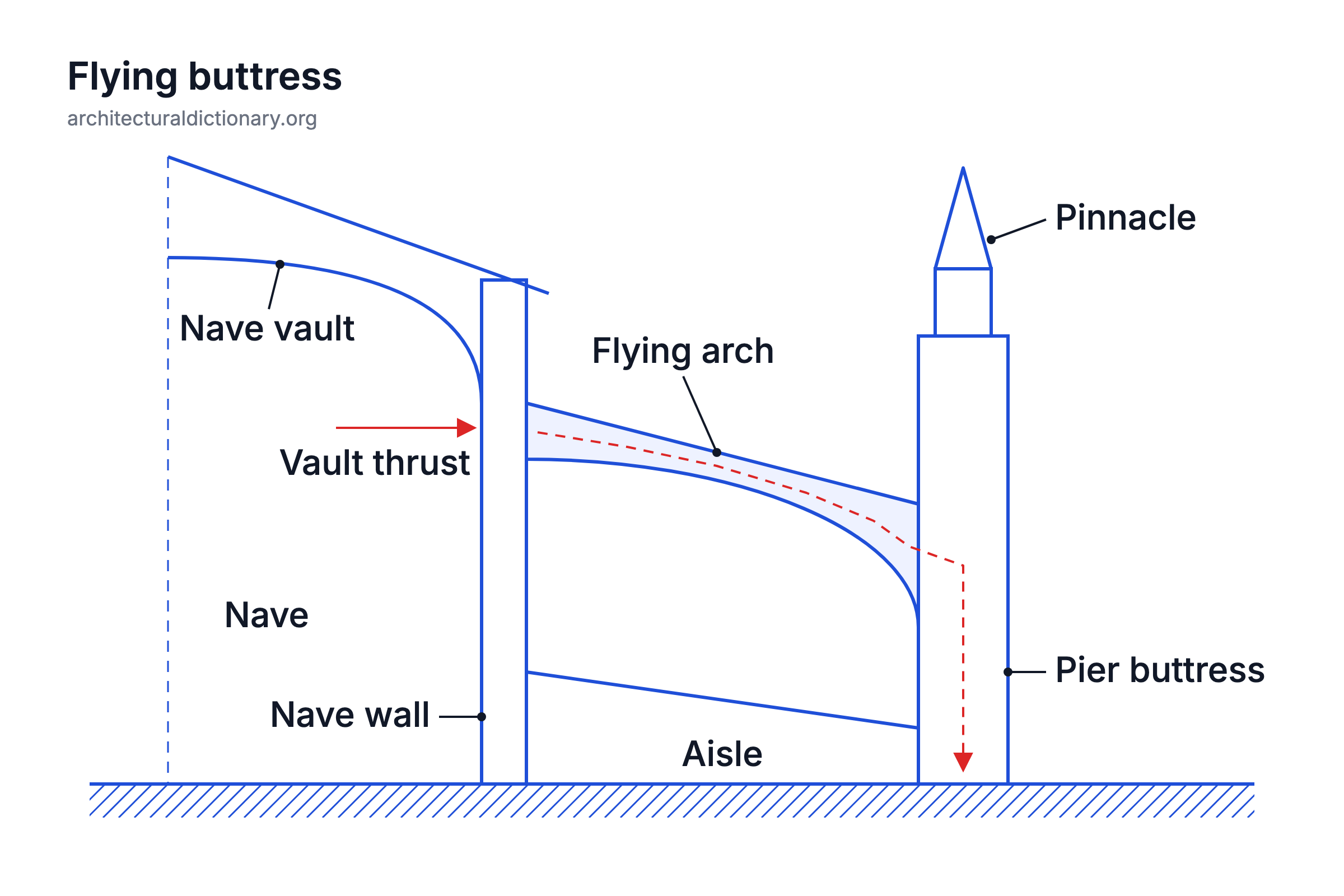 (open the full size diagram)
Save to Pinterest (opens in a new tab)
How a flying buttress works
A high stone vault pushes outward on the walls that support it. In a church with side aisles, a solid buttress cannot be placed against the upper nave wall without blocking the aisle. A flying buttress solves the problem with an inclined half arch, the flyer, that leaps over the aisle roof from the upper wall to a tall pier buttress on the outside. The thrust travels along the flyer into the pier and then down to the foundations. Heavy pinnacles often crown the piers, adding weight that helps turn the thrust downward.
Flying buttresses were developed in northern France in the twelfth century and became a defining feature of Gothic cathedrals such as Notre-Dame de Paris, Chartres, Reims and Amiens.
Because the flying buttresses take the outward thrust, the walls between them can be thinner and opened up with large clerestory windows filled with stained glass, giving Gothic interiors their height and light. Many cathedrals have two tiers of flyers, one near the level of the vault and another higher up, commonly explained as resisting wind pressure on the roof, and some cross double aisles in two flights. A flying buttress differs from an ordinary pier buttress in that it is detached from the wall it supports for part of its length, transmitting force across open space through an arch rather than through a continuous mass of masonry.
Famous examples of Flying buttress
-
Notre-Dame de Paris
Long flying buttresses ring the choir and nave, carrying the thrust of the high vaults over the double aisles to outer piers.
-
Chartres Cathedral
Massive flying buttresses in several tiers support the high vaults and made possible a tall clerestory of stained glass.
Frequently asked questions
What is the difference between a flying buttress and a buttress?
A pier buttress is a solid mass built directly against the wall it strengthens. A flying buttress is separated from the wall by open space and carries the thrust to a pier through an arch, which lets it reach over an aisle roof to support a tall upper wall.
Why do flying buttresses have pinnacles?
A pinnacle adds weight to the top of the pier buttress. That extra weight combines with the sideways thrust from the flyer to direct the resulting force more steeply down into the pier and its foundation.
Why were flying buttresses used in Gothic cathedrals?
They allowed builders to raise very high vaults while keeping the upper walls thin and filled with windows. The thrust that would otherwise push the walls outward is carried away to piers standing outside the aisles.
Sources
Cite this term
Architectural Dictionary. (2026, November 15). Flying buttress. In Architectural Dictionary. https://architecturaldictionary.org/gothic-medieval/flying-buttress
"Flying buttress." Architectural Dictionary, 15 Nov. 2026, https://architecturaldictionary.org/gothic-medieval/flying-buttress.
Architectural Dictionary. "Flying buttress." Last modified November 15, 2026. https://architecturaldictionary.org/gothic-medieval/flying-buttress.