Corinthian order
The Corinthian order is the most ornate of the three Greek classical orders, distinguished by a tall bell-shaped capital decorated with rows of acanthus leaves and small corner volutes, set on slender fluted columns.
Topic glossary
Definitions of classical architecture terms, from the Doric, Ionic and Corinthian orders to entablatures, pediments, pilasters and porticoes.
7 terms
Classical architecture began with the temples of ancient Greece and Rome and has been revived again and again, in the Renaissance, in Palladian country houses, in neoclassical museums and in the banks and courthouses of the nineteenth and twentieth centuries. Its vocabulary is precise, and the same few words describe buildings separated by more than two thousand years.
At the heart of the system are the orders: the Doric, Ionic and Corinthian, later joined by the Roman Tuscan and Composite. An order is more than a style of column. It is a complete set of parts and proportions, from the base and shaft of the column to its capital and the entablature it carries, and each order has its own character, from the sturdy Doric to the ornate Corinthian.
Terms such as pediment, portico and pilaster describe how these parts are assembled into a building. A portico reproduces the front of a temple, a pediment crowns it, and pilasters carry the rhythm of columns across a flat wall. Once you can name these elements, a classical facade becomes much easier to read.
Each entry in this glossary gives a short definition, explains how the element is built and used, points to well known buildings where it appears, and links to related terms so you can follow the system from column to cornice. Where it helps, a labelled elevation shows how the parts fit together.
The Corinthian order is the most ornate of the three Greek classical orders, distinguished by a tall bell-shaped capital decorated with rows of acanthus leaves and small corner volutes, set on slender fluted columns.
The Doric order is the simplest of the classical orders, with sturdy fluted columns, a plain cushion-shaped capital and a frieze of alternating triglyphs and metopes; Greek Doric columns stand without a base.
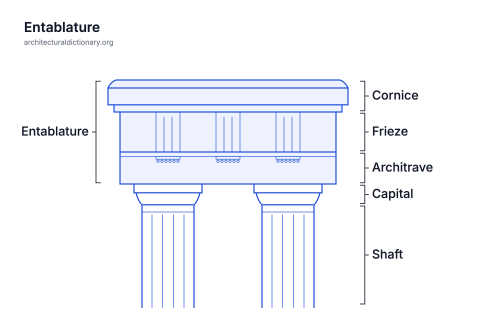
An entablature is the horizontal superstructure resting on the columns of a classical building, made up of three bands: the architrave at the bottom, the frieze in the middle and the cornice at the top.
The Ionic order is a classical order recognised by the pair of scroll-shaped volutes on its capital, with slender fluted columns standing on moulded bases and an entablature that often has a continuous frieze.
A pediment is the low triangular gable that crowns the front of a classical building above the entablature, framed by horizontal and sloping cornices and enclosing a flat field called the tympanum.
A pilaster is a shallow, flat rectangular column that projects slightly from a wall, with a base, shaft and capital, used to divide and decorate a facade while giving the appearance of a column.
A portico is a porch leading to the entrance of a building, formed by a roof supported on a row of columns and often topped by a pediment, as on the front of a classical temple.