Entablature
An entablature is the horizontal superstructure resting on the columns of a classical building, made up of three bands: the architrave at the bottom, the frieze in the middle and the cornice at the top.
Origin From Italian intavolatura, via French.
Sample entry from the theme's demo content, shown to preview the layout.
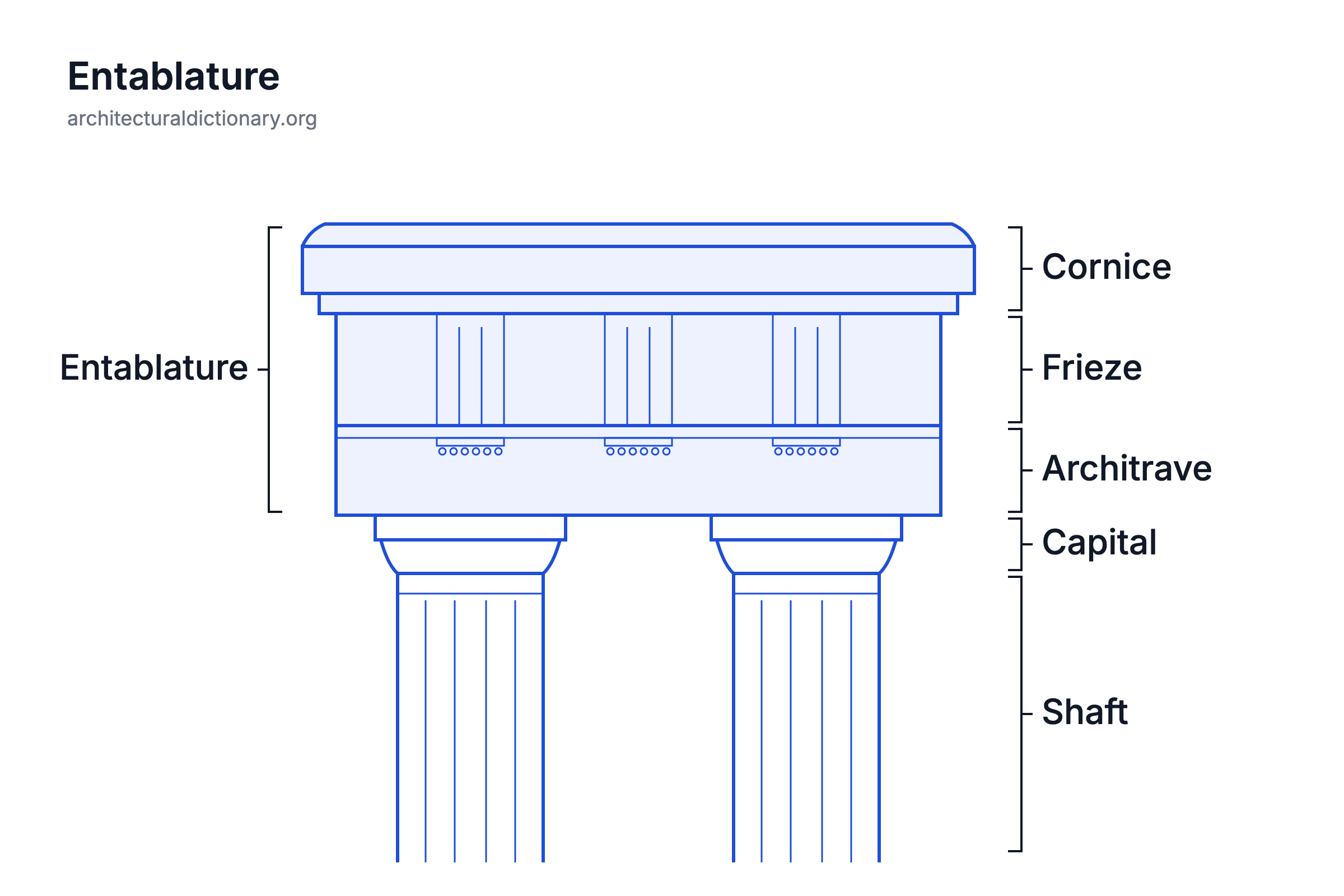 (open the full size diagram)
Save to Pinterest (opens in a new tab)
Parts of an entablature
An entablature sits on top of a row of columns and is divided horizontally into three main parts. The architrave, the lowest band, spans from column to column as the main beam. The frieze above it is a broad band that may be plain or decorated. The cornice at the top projects outward, throwing rainwater clear of the wall below and forming the base of the roof edge or the pediment. Each part is further divided into mouldings whose profiles and proportions follow the rules of the order.
Following Vitruvius, many details of the stone entablature are often explained as translations of the timber beams and rafters used in early Greek temples.
The entablature changes with each classical order. In the Doric order the frieze is divided into triglyphs, blocks with vertical grooves, and metopes, the panels between them, which were often carved. The Ionic entablature usually has an architrave stepped into three bands, called fasciae, a continuous frieze, and a row of small blocks called dentils under the cornice. The Corinthian entablature is the most elaborate, often with ornamental brackets called modillions supporting the cornice. Its height is set in proportion to the diameter of the column, so a correctly drawn entablature looks balanced with the columns below. Entablatures are also used without free-standing columns, carried on pilasters or running around a building as a decorative band.
Famous examples of Entablature
-
Parthenon
Its Doric entablature has a plain architrave and a frieze of triglyphs alternating with sculpted metopes.
-
Maison Carrée
A well preserved Roman temple whose Corinthian columns carry a continuous entablature around the whole building.
Frequently asked questions
What is the difference between an entablature and an architrave?
The architrave is only the lowest of the three bands of an entablature, the part that rests directly on the column capitals. The entablature is the whole assembly of architrave, frieze and cornice.
What is the difference between a frieze and a cornice?
The frieze is the middle band of the entablature, often decorated with triglyphs and metopes or continuous relief sculpture. The cornice is the projecting top band that crowns the entablature and sheds rainwater.
How does the entablature differ between the orders?
The Doric entablature has a frieze of triglyphs and metopes, the Ionic usually has a three-banded architrave, a continuous frieze and dentils, and the Corinthian is the richest, often adding modillions under the cornice. All three keep the same basic sequence of architrave, frieze and cornice.
Sources
Cite this term
Architectural Dictionary. (2026, November 15). Entablature. In Architectural Dictionary. https://architecturaldictionary.org/classical/entablature
"Entablature." Architectural Dictionary, 15 Nov. 2026, https://architecturaldictionary.org/classical/entablature.
Architectural Dictionary. "Entablature." Last modified November 15, 2026. https://architecturaldictionary.org/classical/entablature.