Term of the week: Flying buttress
By admin,
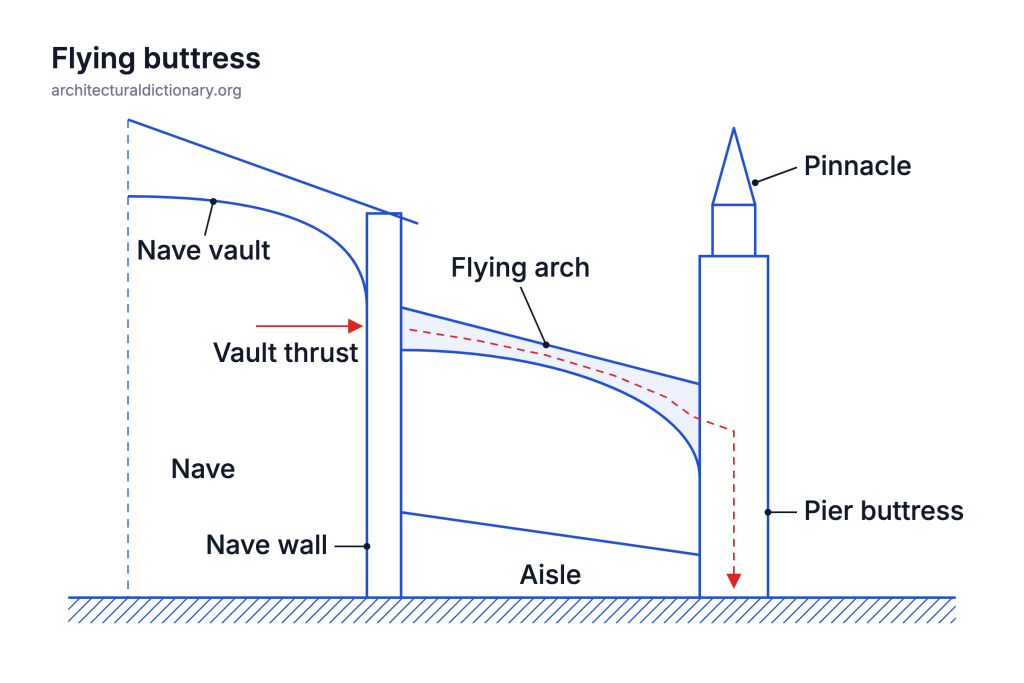
This week’s term is the flying buttress, the feature that gives Gothic cathedrals their skeleton-like silhouette.
The problem it solves
A stone vault does not only press down. Like every arch, it also pushes outward, and the higher the vault, the harder it is to stop that push from overturning the walls. Romanesque builders answered with thick walls and small windows. Gothic builders moved the support outside.
How it works
A flying buttress is a half arch that springs from a pier standing outside the aisles and leans against the upper wall of the nave, just where the vault pushes outward. It carries that thrust across the roof of the aisle and down into the heavy outer pier, often weighted by a pinnacle. Because the vault’s thrust is gathered by ribbed vaults into a few points, the wall between those points carries very little and can be filled with glass, which is what made the tall clerestory possible.
Where to see it
Notre-Dame de Paris and Chartres Cathedral both have long ranges of flying buttresses around their naves and choirs. Look at them from the side and you can follow the whole path of the load, from the vault to the ground.